
I am still shaking the dust of the Wainyapu plains from my linens, yet my spirit remains firmly anchored in the Sumba highlands.
Returning from our most recent MANAMU Cultural Adventure to Sumba Island is always a process of recalibration. It is the difficult transition from “Clock Time”—the frantic rhythm of the global design market—back into “Ancestral Time,” where the pace of life is dictated by the moon, the tides, and the arrival of the sacred Nyale sea worms.
The Rhythm of Welcome: Luluk Panggara Taungu
Our immersion began not with a speech, but with a heartbeat. As we entered the village, we were met by the Luluk Panggara Taungu—the traditional welcoming ceremony that serves as the social and spiritual gateway to the highlands.
In the local dialect, the name itself carries the weight of the community’s soul: Luluk refers to ritual speech and songs of praise; Panggara means to call or evoke a spirit of enthusiasm; and Taungu relates to the people or the communal season. Together, Luluk Panggara Taunguis a collective call to mark a grand event—a way for the Sumba people to tell both the world and the Divine that they are in a state of joy.
To hear the resonant bronze of the gongs and watch the rhythmic movements of the dancers is to be told, without words, that you are no longer a stranger. But the true “breath” of this celebration lies in the vocalizations: the Kakalak—the high-pitched, spirited shouts of the men—and the Kayaka of the women. These are not merely sounds; they are the energy that fuels dances like the Ninghugarama or Kabokang. Every stomp of a dancer’s foot is synchronized with these pekikan, creating an atmosphere that is as magical as it is festive. It reminded us that before we talk about “design,” we must first talk about “connection.”
The Thunder of the Pasola
On March 11th, we stood on the edge of the ritual plains in Southwest Sumba to witness the Pasola. To the uninitiated, it looks like chaos: mounted horsemen at full gallop, hurling wooden spears with a velocity that seems to defy gravity. But to those who listen, it is a prayer.
Witnessing the Pasola is a reminder of the raw “Ancestral Instinct” that fuels our brand. There is a deep, visceral connection between the spirit and the soil here. Historically, the blood spilled in this ritual is seen as a sacred sacrifice to fertilize the earth for a bountiful harvest. It is a powerful, humbling reminder that in Sumba, beauty and survival are inextricably linked.
The Architecture of the Loom: Ikat & Pahikung
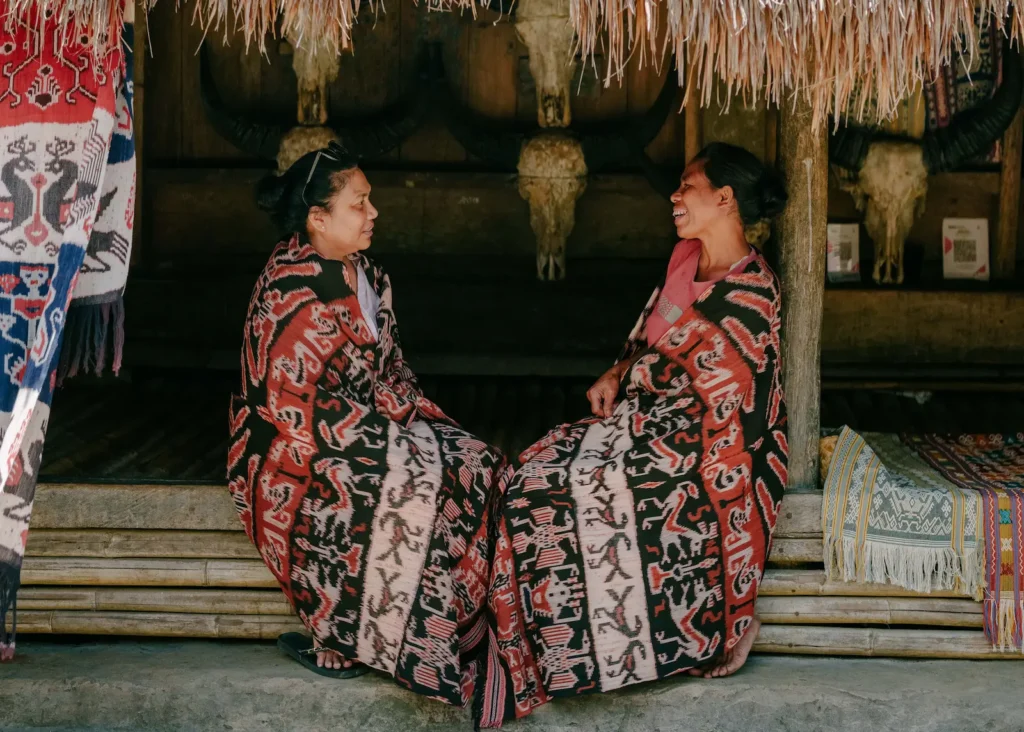
A highlight of our journey was the time spent at both our Ikat & Pahikung weaving houses, our partners in preserving the “Sculptural Heritage” of the loom. While the world knows Sumba for its Ikat—the “Art of the Dye”—we were captivated by its technically demanding sibling: Pahikung (or Pahudu).
Ikat is like a painting, where the pattern is dyed into the threads before weaving. But Pahikung is a sculpture. By adding supplementary warp threads during the weaving process, the artisans create a raised, tactile relief. Sitting with the weavers, I saw the direct parallel to our metalwork. Whether it is cotton thread or copper wire, we are both engaged in the “Architecture of the Thread”—building structures with physical depth and structural integrity. Using 100% botanical dyes (like Indigo and Morinda), these masterworks are a testament to the botanical wisdom of the island.
Sitting with Hand-Wisdom
Leaving the looms behind, we travelled into the quiet sanctuary of our metal-weaving villages. There is a specific kind of silence that exists when our master artisans are at work. It is not an empty silence, but one filled with the rhythmic pull of metal wire—the sound of Lulu Amahu being born.
Sitting on the bamboo floors of the Uma Mbatangu (peaked houses) with our weavers, I was reminded again of why we created MANAMU. To watch an elder’s hands, move with such precision—what we call “Hand-Wisdom”—is to watch over a 1000-year-old architectural language being spoken in real-time. These hands are not just making jewelry; they are preserving a cultural sovereignty that machines can never replicate.
The Regenerative Shift
This trip confirmed that our move toward Regenerative Hospitality is working. I saw firsthand the impact of our Master-Apprentice Program. I met young weavers who, instead of migrating to cities for unskilled labour, are choosing to stay in their ancestral villages. They are being paid a “Heritage Premium” to learn the “Woven Engineering” of their forefathers.
By scaling these ancient knots into the grand-scale installations of our new LULU AMAHUbrand, we aren’t just selling “products.” We are providing the economic oxygen required for a megalithic culture to breathe in a modern world.
The Light We Carry Back
As I look at the prototypes for our new Steel and Copper installations sitting in my Sanur gallery, I no longer just see “Design.” I see the flash of a horseman’s eyes at the Pasola. I see the weathered, expert grip of a master weaver. I see the resilience of an island that is truly “Timeless. Untamed. Unforgettable.”
To our guests who joined us on this adventure: Thank you for traveling with an open heart. You didn’t just witness a culture; you became stakeholders in its survival.
To those yet to join us: The highlands are calling. The weave is waiting.